Butter Churner Position: What It Is and Where It Can Hurt
What is the butter churner position? A plain guide to the butter churner sex position, how it compares with the pile driver, its injury risks and safer swaps.

General education, not medical advice. If something here worries you, talk with a clinician.
Table of Contents
The butter churner position is a folded, upside-down sex position. The receiving partner rests on their shoulders and upper back with the hips and legs lifted overhead, and the other partner squats or stands above them. Its name comes from the up-and-down movement, which guides compare to working an old hand churn.
Our view is that this is a position to understand before you try it, and that for most couples a supported version gets most of what it offers. Magazine guides rank it among the hardest positions they list, and most of that difficulty is physical load. The neck carries weight while bent, the head sits below the hips, and the partner on top holds a deep squat.
Below you will find how the position is arranged, where the guides disagree, and what each body part risks. The last sections cover gentler swaps and the signs that pain afterwards needs a doctor.
How the butter churner is set up, and where sources differ
Who is where in the butter churner position
The receiving partner starts flat on their back, then rolls the hips up until their weight rests on the shoulders, upper back and elbows. Their hands usually brace the hips, much like a yoga shoulder stand, and the other partner squats above with one foot on either side. That partner does the moving, bending and straightening at the knees and hips.
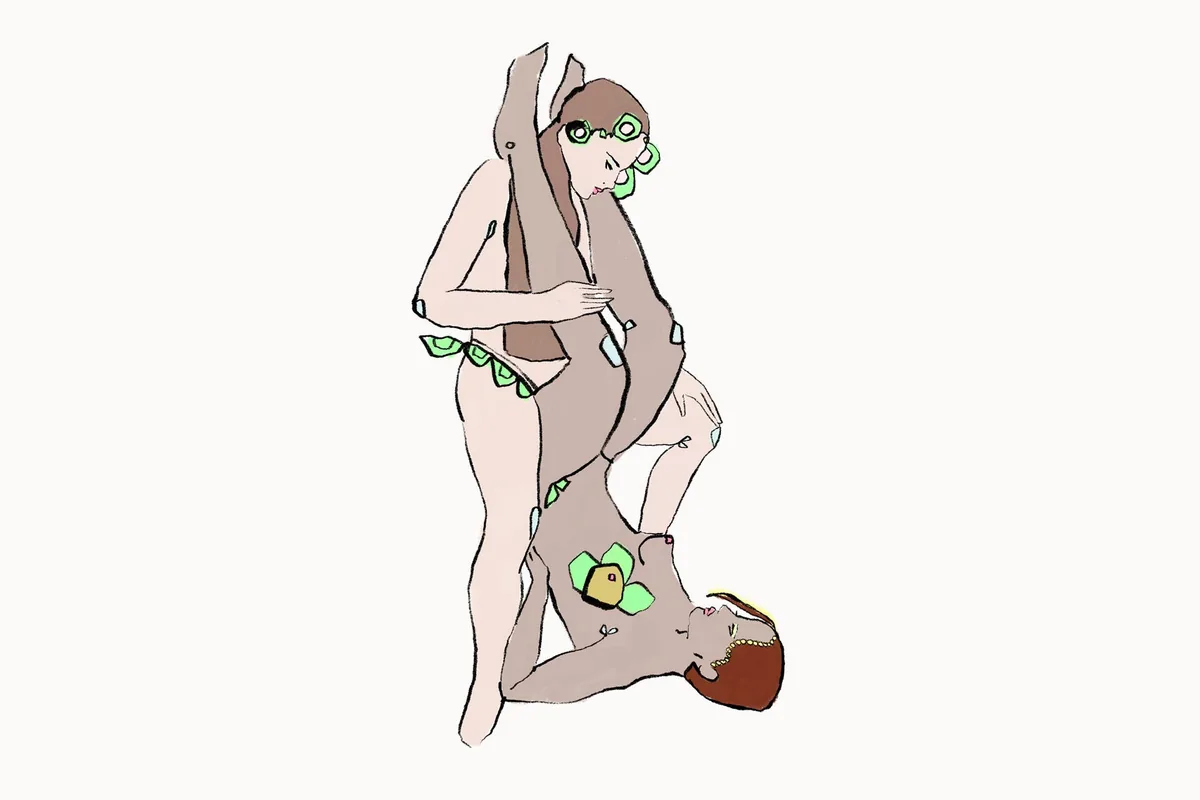
Set it up on the floor or against something solid, not in the middle of a mattress. A shoulder stand rests on a small patch of shoulders and elbows, and a soft mattress gives unevenly under it, so the base shifts with every movement above. A wall, the front of a couch or the edge of the bed gives the receiver something to brace against. Folded blankets under the shoulders, the way yoga teachers set up the similar plow pose, leave a little space between the back of the neck and the floor.
Where the guides disagree
The biggest split is the legs. Most of the guides used here cross or bend them in front of the top partner, in more of a full shoulder stand; one retailer guide lifts them up and over the head. Men’s Health treats legs behind the head as the mark of the pile driver, so the two names blur at the edges. If you try either, start with the legs in front. Over the head, the lower back rounds further and the hamstrings are stretched while carrying weight, as the injury section below explains.
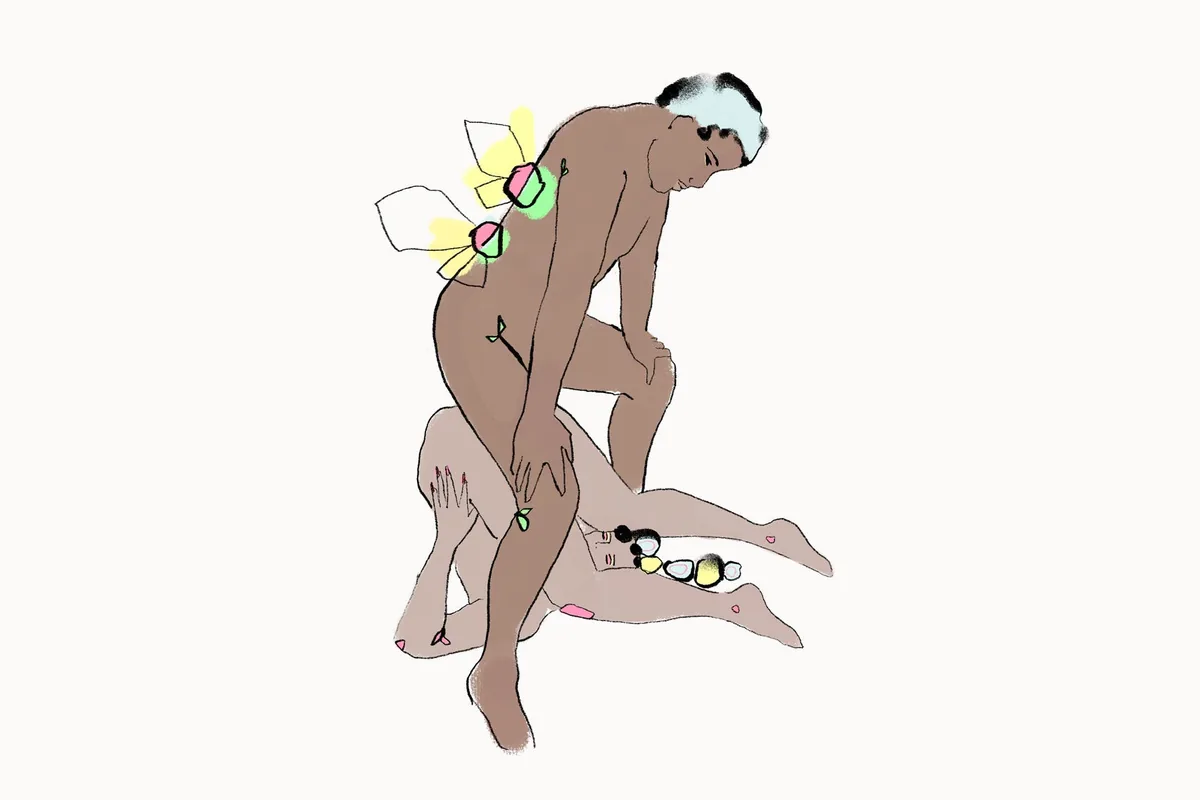
The top partner’s stance varies too: standing and holding the ankles, squatting, or kneeling. Kneeling is the one to start with, because it lifts the receiver’s back less and keeps the top partner low and steady. Some guides also call the whole thing the squat thruster.
You may also see the name “reverse butter churner position.” None of the guides checked for this page defines it, so ask a partner what they picture before trying it.
The benefits people try it for
The draws are a deep angle, a receiver who can hold still while the partner moves, and the novelty of managing something hard. Some people enjoy the head rush; for others the same rush brings nausea or light-headedness.
Laurie Mintz, PhD, quoted by Cosmopolitan, is blunter about the whole family of positions. Her view is that the appeal is mostly psychological: a shared challenge rather than a reliable route to pleasure. That matches the trade-off on this page. If the challenge is the point, it makes sense as an occasional experiment, not a regular position.
Butter churner vs pile driver vs full nelson
The butter churner belongs to a small family of folded positions. Its closest relatives are the pile driver and the full nelson, and the differences come down to where the weight goes and who moves.
| Butter churner | Pile driver | Full nelson | |
|---|---|---|---|
| Who carries the weight | The receiver’s shoulders, upper back and elbows | The receiver’s shoulders and upper back, with the torso off the bed | The partner underneath carries the whole weight of the partner on top |
| What folds | Hips overhead; legs crossed or bent in front, or over the head in some guides | Legs pulled back behind the head | Legs raised in a V and held back by the other partner’s arms |
| Who moves, and how | The top partner squats above and moves up and down | The top partner straddles from above and leans forward | The partner underneath holds the legs, often with hands locked behind the neck |
| Main risk | Neck bent under load and head rush; repeated squatting strains the top partner’s knees | Head rush and fainting; a downward angle that may make penile fracture more likely | Severe neck injury and difficulty breathing for the partner on top |
The butter churner and the pile driver (also spelled piledriver) are close cousins. Both are inverted, and both put a partner’s movement above a neck that is already bent. The main difference is leg placement. Our pile driver guide covers that position’s own neck load and safer swaps.
The full nelson works differently. Nobody is upside down, but the hold can force the neck into a bend the held partner cannot ease. WebMD notes that the wrestling move it is named after is illegal in amateur wrestling because of injury risk.
Butter churner sex position injury risks, body part by body part
No study has counted injuries from this position, so the risks below come from what each body part is asked to do. Each one is matched to what orthopedic, eye and urology sources say about the same kind of load.
Neck and upper back
In a shoulder stand, the neck is bent forward with the hips and legs stacked above it. Orthopedic surgeons at AAOS say neck sprains and strains follow when the neck is bent or twisted in an abnormal way. No source has tested whether this position causes that kind of injury. Yoga teachers do warn that the same shape can overbend the neck and compress the cervical spine.
The pain can also arrive late, hours afterwards or even the next day. That is why AAOS advises seeing a doctor after a neck injury even if you feel fine, and why feeling fine during the position proves less than it seems.
Two habits from yoga carry straight over: keep a little space between the back of the neck and the floor, and never turn the head while inverted. In this position that means taking the weight on the elbows rather than the neck.
Lower back and hamstrings
To get the hips overhead, the lower spine rounds forward about as far as it goes. For anyone with a disk problem, forward bending should stay slow and controlled, and a rhythm set by someone moving above you is hard to keep slow. That alone is a reason to pick a swap if your lower back has a history.
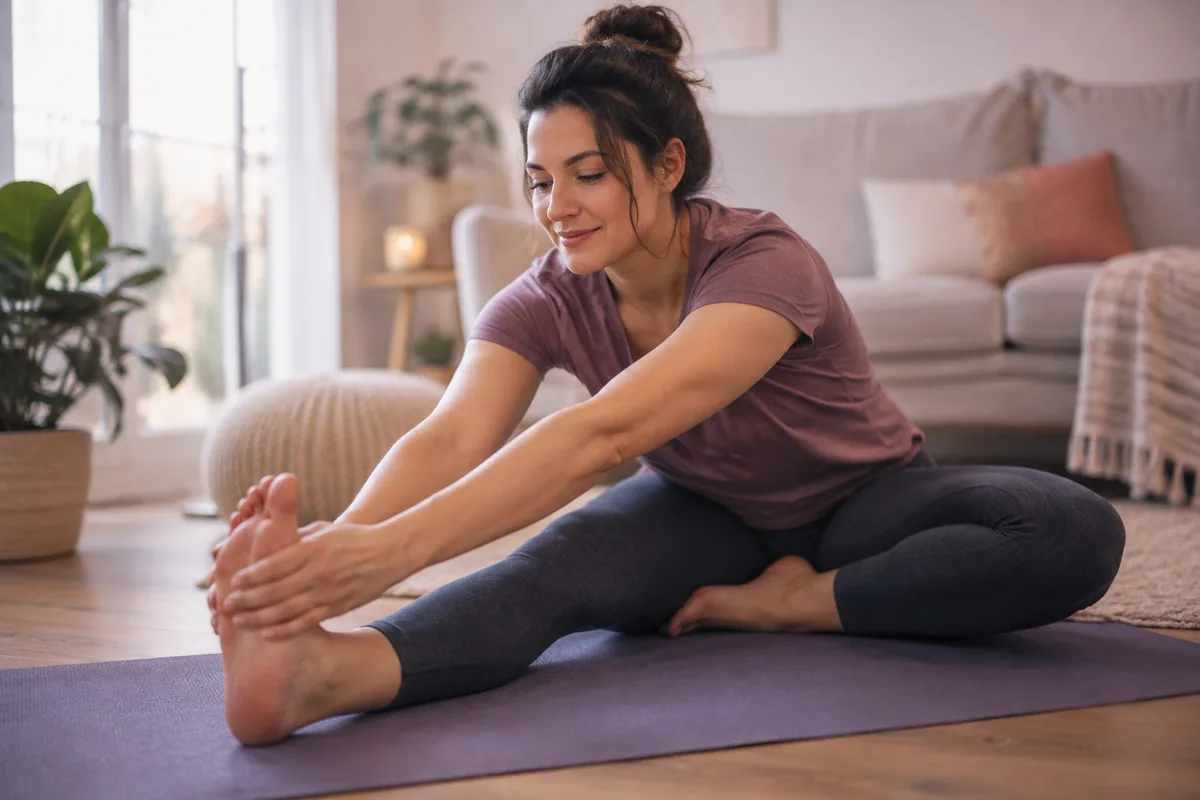
The legs add a second load. In the legs-over-the-head version, the hamstrings along the back of the thigh are stretched and bearing weight at the same time. That is the combination behind most hamstring strains: a muscle stretched to its limit and then hit with a sudden load.
The squatting partner’s knees and thighs
The partner on top holds a deep squat and moves from it. Repeated squatting is a known trigger for pain around the kneecap (patellofemoral pain syndrome). Thighs also tire quickly in a held squat, and tired legs start to wobble just when balance matters most.
That wobble matters more here than in most positions, because a fall lands on someone balanced on their neck. Stop while the thighs are still fresh, not once they start to shake.
Penile angle
When the penetrating partner has a penis, the steep downward angle adds a specific risk. Cleveland Clinic says a penile fracture often happens when the penis slips out and the next thrust bends it against the partner’s body, and it treats that injury as an emergency. Our reverse cowgirl guide explains the causes and warning signs in full.
Breathing and blood pressure when folded
With the hips above the head, blood shifts toward the head. Some people find that rush exhilarating, while others feel nauseated or light-headed. WebMD gives a firmer warning for the pile driver: too much blood to the head can make someone pass out.
The eyes register the shift as well. In a small study of 20 people, eye pressure rose within a minute in every head-down yoga pose tested, including plow pose. It returned to normal within two minutes of sitting up.
Breathing also suffers. Folding the knees toward the chest compresses the ribcage, and yoga teachers note that people in plow pose tend to hold their breath. Breathe out on purpose while folded; if you cannot, come down. If head-down positions interest you, the waterfall position raises the same question in a milder form.
Who should skip the butter churner
The short answer: if you are not already comfortable in a shoulder stand, or you dislike being upside down, there is nothing here worth pushing through. Beyond that, these situations raise the stakes, and some call for a doctor’s view first:
- Neck or back pain, or a past injury. Yoga Journal tells people with neck or back pain or injuries, including bulging or herniated discs, to avoid the plow pose, which has the same shape.
- A pinched nerve in the neck. AAOS says straining the neck or turning the head can make that pain worse.
- Glaucoma or other eye conditions. Head-down poses raise eye pressure, and Yoga Journal suggests asking an eye doctor before trying an inversion.
- Feeling faint with your head down. Too much blood rushing to the head can make a person pass out, so a history of fainting is a reason to skip it.
- Pregnancy. Cleveland Clinic explains that after about 20 weeks, lying flat on the back lets the uterus press on major blood vessels.
- Knee pain for the partner on top. A deep, repeated squat is the movement that tends to aggravate kneecap pain.
- Recent surgery. After any neck, back, shoulder, hip or knee operation, ask your surgeon when folded positions are safe again.
- A large size difference. Both partners have to keep their balance throughout, and that gets harder when the partner on top is much heavier or taller. Start with a gentler swap.
High blood pressure is a common question with any head-down position. The sources used here do not address it directly, so ask your doctor rather than guessing.
Gentler swaps and what each keeps
Most of what people want from the butter churner is a steep angle, raised hips and a sense of trying something new. Each of the swaps below keeps some of that while moving some or all of the weight off the neck. None is risk-free; the table says what actually changes.
| Gentler swap | What it keeps | What it loses |
|---|---|---|
| Supported plow: a large firm pillow under the hips, legs hanging over the body | Raised hips and a steep angle | The balancing act: the pillow, not the shoulders, holds up the hips. The neck can still bend and the head may still sit below the hips, so it is gentler, not risk-free |
| Legs-up missionary, with the receiver’s legs over the partner’s shoulders | Depth and a folded feel | The acrobatics and the head-down angle; in return, Mintz says it is not likely to cause injury |
| Missionary with a pillow or rolled towel under the lower back or hips | Hips tilted up, face to face | Less fold, so less depth |
| Edge of the bed, receiver’s hips near the edge, partner standing | A partner standing above; the legs can still lift | The head-down rush and the full fold |
| Low-effort lying-down positions | Closeness and the option to last longer | The steep angle and the novelty |
| Kneeling butter churner, with the partner on top kneeling | The same basic shape | Some height; the receiver’s back is lifted less, with less worry about falling |
If you want one place to start, make it the supported plow: it keeps the angle people come for and takes the balancing act away. Whichever you choose, move from the hips and knees rather than the spine, and use a small pillow to support the neck, back or hips, as Healthline suggests. A firm foam wedge holds its shape better than a soft pillow, but firm is not the same as non-slip, so set it on a surface where it stays put.
When pain after sex needs a doctor
Sore thighs versus a sore neck
Tired, achy thighs for the partner who squatted are ordinary muscle soreness. A sore neck for the partner who was folded is different. AAOS advises seeing a doctor after a neck injury to get an evaluation even if you feel fine, because an exam or imaging may be needed to rule out a fracture or dislocation.
Once a doctor has confirmed a sprain or strain, AAOS home care applies: an ice pack for 15 to 30 minutes at a time, several times a day for the first 2 or 3 days, wrapped in a towel rather than against bare skin. Most neck sprain symptoms go away in 4 to 6 weeks. Do not test the position again while it still hurts. Pain that stays constant, or severe pain that over-the-counter painkillers do not relieve, is on its list for immediate medical attention.
Get emergency help now
These signs need urgent care straight away, not a wait-and-see approach:
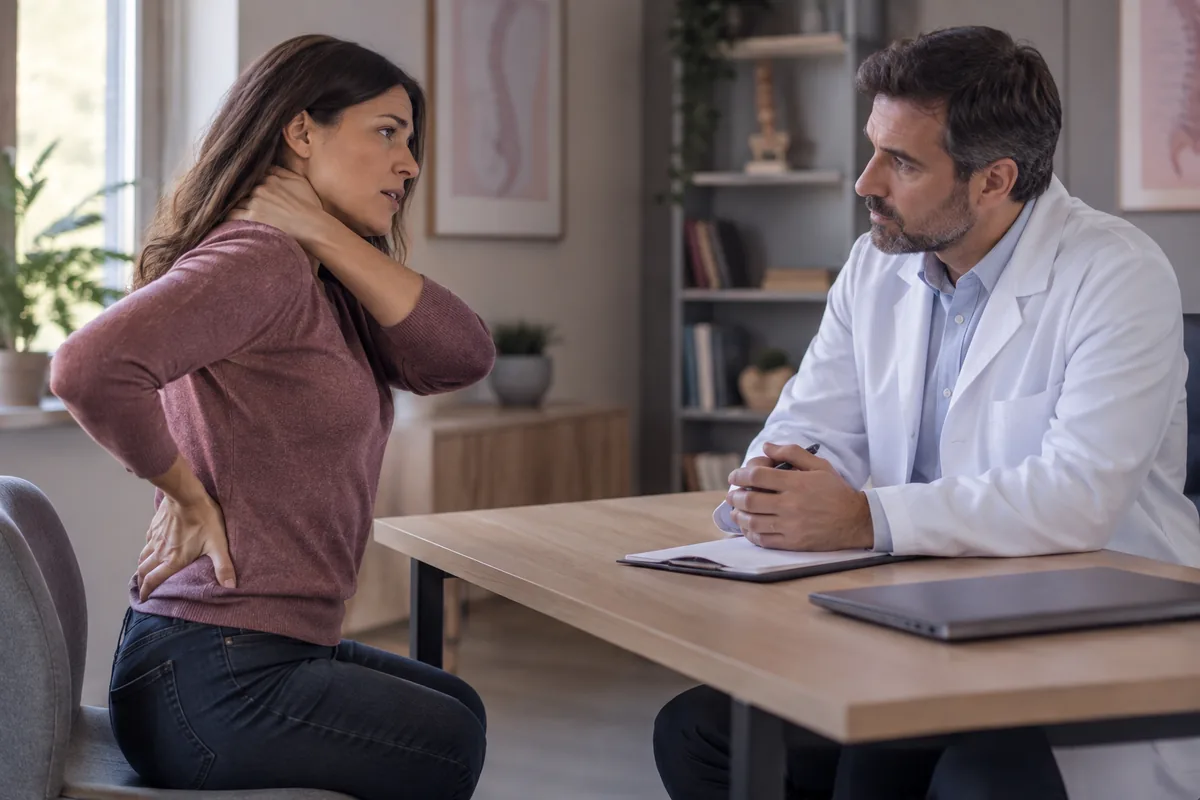
- Neck pain that shoots down an arm, or comes with numbness, tingling or weakness. AAOS says these call for immediate medical attention. A pinched nerve in the neck can cause exactly these arm symptoms.
- A popping sound, sudden loss of erection, pain and swelling. These point to a penile fracture, which Cleveland Clinic calls an emergency.
- A sudden, severe headache during or after sex. The NHS says to get emergency care for a headache that started suddenly and is extremely painful. Most sex headaches are harmless, but a small share come from serious causes such as bleeding in the brain.
- Loss of bladder or bowel control with back pain. AAOS calls this rare and a medical emergency.
If any of these happen, stop immediately. For a sudden, severe headache, the NHS in the UK says not to drive yourself to A&E but to ask someone to drive you or call 999. Elsewhere, call your local emergency number. If neck pain comes with tingling, numbness or weakness, keep the head and neck as still as you can while you wait for help.
FAQ: quick answers before you try it
What is the meaning of butter churner?
It is slang for an inverted sex position. The receiving partner balances on their shoulders with the hips overhead, while the other partner moves up and down above them. One guide says the motion looks like an old-fashioned butter churn, which is where the name comes from. There is no official definition, and guides differ on where the legs go.
Is the butter churner position dangerous?
No study has measured injuries from it or compared it with other positions, so its risk cannot be ranked. What is known is the load: the neck stays sharply bent with body weight above it, and AAOS links neck sprains and strains to the neck being bent or twisted in an abnormal way. The head-down angle can cause light-headedness, and the partner on top has to hold a deep squat throughout. Keeping it brief and using a stable base are sensible precautions rather than proven fixes; a gentler swap avoids most of the load.
What is the reverse butter churner position?
The name turns up in searches, but none of the health or magazine sources checked here defines it. If a partner suggests it, ask exactly what they mean before trying anything. Any version that keeps the hips overhead keeps the same load on the neck.
Is the butter churn position the same as the pile driver?
They are closely related, and some guides use the two names loosely. Men’s Health says the difference is mostly leg placement: legs behind the head for the pile driver, crossed in front for the butter churner. The pile driver guide covers that position separately.
Is the butter churner worth the risk?
The butter churner position offers a steep angle and the novelty of pulling off something hard. In return it puts body weight on a bent neck, sends blood to the head and asks the partner on top for a long, deep squat. That is a lot of load for a payoff that is mostly the challenge itself.
For most couples, the supported plow gets most of the way there. A firm pillow under the hips and the legs resting over the body keep the angle without the shoulder stand. If you do try the full version, use a firm floor and keep it short. Agree first on a stop signal that needs no words and works while the hands are bracing the hips, such as a sound you both recognise. Stop at the first neck pain or dizziness, and treat tingling or numbness in the arms as a reason to call for help, not to try again.
Related reading
- Pile Driver Position: What It Is, Where It Strains the Neck, and Safer Swaps
- Full Nelson Sex Position: What It Is and Why It Strains the Neck
- Missionary Position: Variations, Angles and Comfort
Sources
- Butter Churner Sex Position: An Illustrated Guide & Expert Tips - Men’s Health
- Butter churner sex position - a guide to the tricky position - Cosmopolitan UK
- The Butter Churner Position: Essential Tips for Better Intimacy - WeLovePlugs (retailer blog)
- How to Do the Piledriver Sex Position Safely and Effectively - Cosmopolitan
- Plow Pose: How to Practice Halasana - Yoga Journal
- Piledriver Sex Position: What It Is - WebMD
- The Full Nelson Sex Position: What It Is And the Challenges Involved - WebMD
- Neck Sprains and Strains - American Academy of Orthopaedic Surgeons (OrthoInfo)
- Patellofemoral Pain Syndrome - American Academy of Orthopaedic Surgeons (OrthoInfo)
- Herniated Disk in the Lower Back - American Academy of Orthopaedic Surgeons (OrthoInfo)
- Hamstring Muscle Injuries - American Academy of Orthopaedic Surgeons (OrthoInfo)
- Penile Fracture: What Is It, Causes, Symptoms & Treatment - Cleveland Clinic
- Intraocular Pressure Rise in Subjects with and without Glaucoma during Four Common Yoga Positions - PLOS One (Jasien et al.)
- Cervical Radiculopathy (Pinched Nerve) - American Academy of Orthopaedic Surgeons (OrthoInfo)
- Is Back Sleeping Harmful When Pregnant? - Cleveland Clinic
- Back Sex: The Best Positions for Back Pain - Healthline
- Headaches - NHS
- Headaches Associated With Sex Are No Joke - NeurologyLive